

Understanding the Harley-Davidson Rev Max 975 Engine
If you’ve been following Harley-Davidson’s lineup over the past few years, you’ve probably heard about their Revolution Max (Rev Max) engine. It’s a major shift from the company’s traditional air-cooled V-Twins — and for better or worse, it represents Harley’s leap into a more modern, performance-oriented era.
Let’s dig into what makes the Rev Max 975 special, where it fits in the Harley world, and how it stacks up against older engines like the Dyna’s.

Where You’ll Find a Rev Max
The Rev Max powers some of Harley’s most progressive models:
Pan America – Harley’s first adventure bike
Sportster S – A muscular, modern spin on a legend
Nightster / Nightster S – The most accessible entry point into the new platform
Each of these bikes shares the same DNA — a compact, liquid-cooled, 60-degree V-Twin designed to blend everyday usability with performance. However, you’ll see a bigger, more powerful Rev Max 1250 in the Pan America and Sportser S.
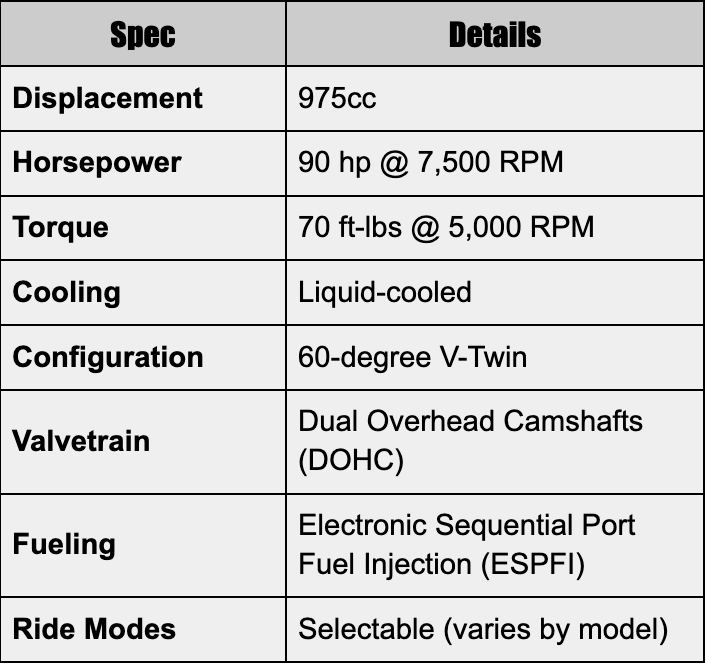
Rev Max 975 Specs
Let’s look at what to expect from the Rev Max 975…
This engine is a complete redesign from the ground up. It’s now a stressed member of the frame, reducing weight and improving rigidity. Harley reports a drop of roughly 150–190 pounds compared to similar air-cooled setups.
Why People Love It
Modern riders — especially daily commuters and weekend travelers — are embracing the Rev Max for what it adds:
Easy, usable power: The torque curve is smooth and predictable. It wakes up when you need it, but it’s controllable.
Liquid-cooling: Keeps performance consistent even in hot traffic or long rides.
Lightweight handling: The reduced weight makes the bike more agile and beginner-friendly.
“Low-touch” maintenance: Thanks to DOHC and hydraulic lifters, there are no valve adjustments needed. Suggested 5k-mile maintenance schedule. And
In short, the Rev Max gives Harley the ability to appeal to riders who might’ve otherwise gone with Yamaha, Triumph, or even Ducati.
Why It Divides Harley Riders
Long-time Harley owners have a few gripes about the Revolution Max:
The Sound: It’s not the deep, throaty rumble of a Milwaukee-Eight or Twin Cam. The liquid cooling and high-revving design naturally tone it down.
The Feel: Internal counterbalancers dramatically reduce vibration, which purists say steals some “soul.”
The Tech: More electronics mean more potential for glitches — a tradeoff for things like selectable ride modes and advanced diagnostics.
For riders who love simplicity, the Rev Max can feel a bit… sanitized. But that doesn’t tell the whole story.
How It Compares to the Dyna
The Rev Max and the old Dyna engines are worlds apart — not just in design, but in philosophy.
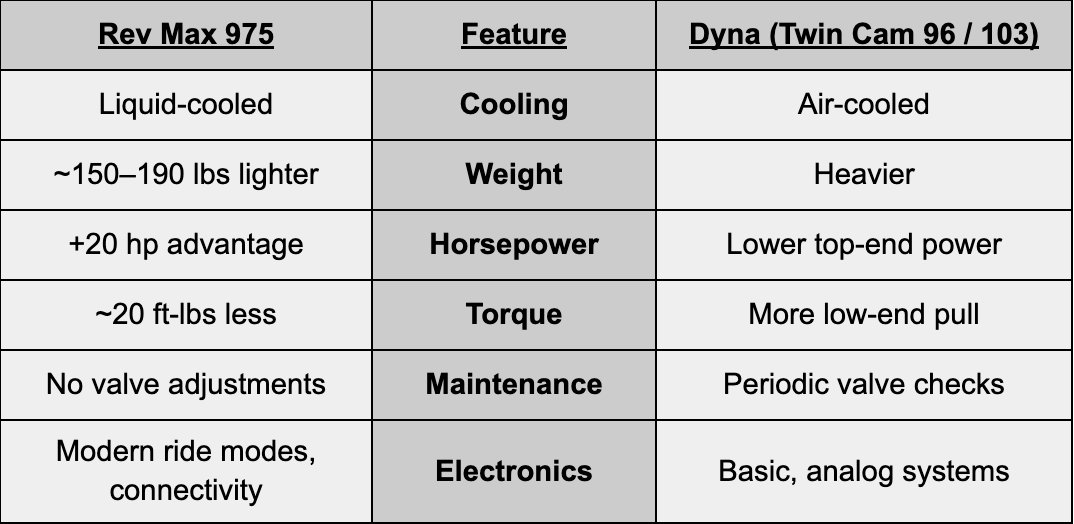
The Dyna feels raw. The vibration of the engine travels through the seat and handlebars – bringing the rider into the moment. The Rev Max feels refined, smooth, and athletic. They deliver two different riding experiences: one built for nostalgia, the other for the next generation of Harley riders.
Style and Comfort
One underrated perk of the Rev Max platform is how it improves ergonomics and ride comfort. The lighter chassis and better balance make these bikes easier to manage, especially in stop-and-go traffic or twisty backroads.
And while some riders miss the throaty big twin, others appreciate being able to finish a two-hour ride without their hands tingling. Harley’s also done a great job designing bikes around this engine.
The Future of the Rev Max (and Harley)
The Revolution Max isn’t just an engine — it’s Harley’s blueprint for survival. Over the next 3–5 years, we can expect Harley to:
Highlight the platform: Showcasing content creators taking these engines through its paces. Finding limits – track builds, mini-touring builds, stunt riding
Refine the electronics: Advanced rider connectivity, and low-cost maintenance.
Bridge tradition and innovation: Balancing classic design cues with reliability and performance.
Attract a new generation: Riders who value performance, versatility, and daily usability over nostalgia alone.
The Dyna generation gave grit and character. The Revolution Max generation is giving us precision and progress. Whether that’s “better” depends on what kind of rider you are — but there’s no denying this engine is reshaping Harley-Davidson.